
A New Era for CRO
Today, we are sharing our perspective on CRO emissions and the changes ahead.
CRO is transitioning from an inflation-funded staking model to a revenue-funded one. This proposal introduces three major changes: wind down emissions gradually, introduce staking tiers that reward longer commitment, and begin replacing inflation with revenue generated by real economic activity.
We aim to introduce a dedicated tokenomics page on cronos.com with visibility into supply, reserve, and revenue flows - so you can know exactly where Cronos stands and where it is going.
This is the beginning of a new economic model for Cronos.
Why this proposal exists
Cronos is moving toward a more sustainable economic model. As the ecosystem develops, the connection between economic activity and the utility of CRO should be stronger, transparent, and verifiable.
Today, CRO supply sits at approximately 98.54 billion out of a 100 billion cap. At the current emission rate, that ceiling is reached within 18 months. This creates an opportunity to build a stronger, revenue-backed model for CRO.
This governance proposal puts forward that model. Here is what is changing.
What is changing
1. Inflation winds down
The amount of new CRO minted will decay approximately 6.8% every month. The number of circulating tokens will get close to but never exceed 100 billion. The decline is gradual and predictable. With decay enabled, supply stabilises well below the 100B cap; without it, the cap is breached by October 2027.
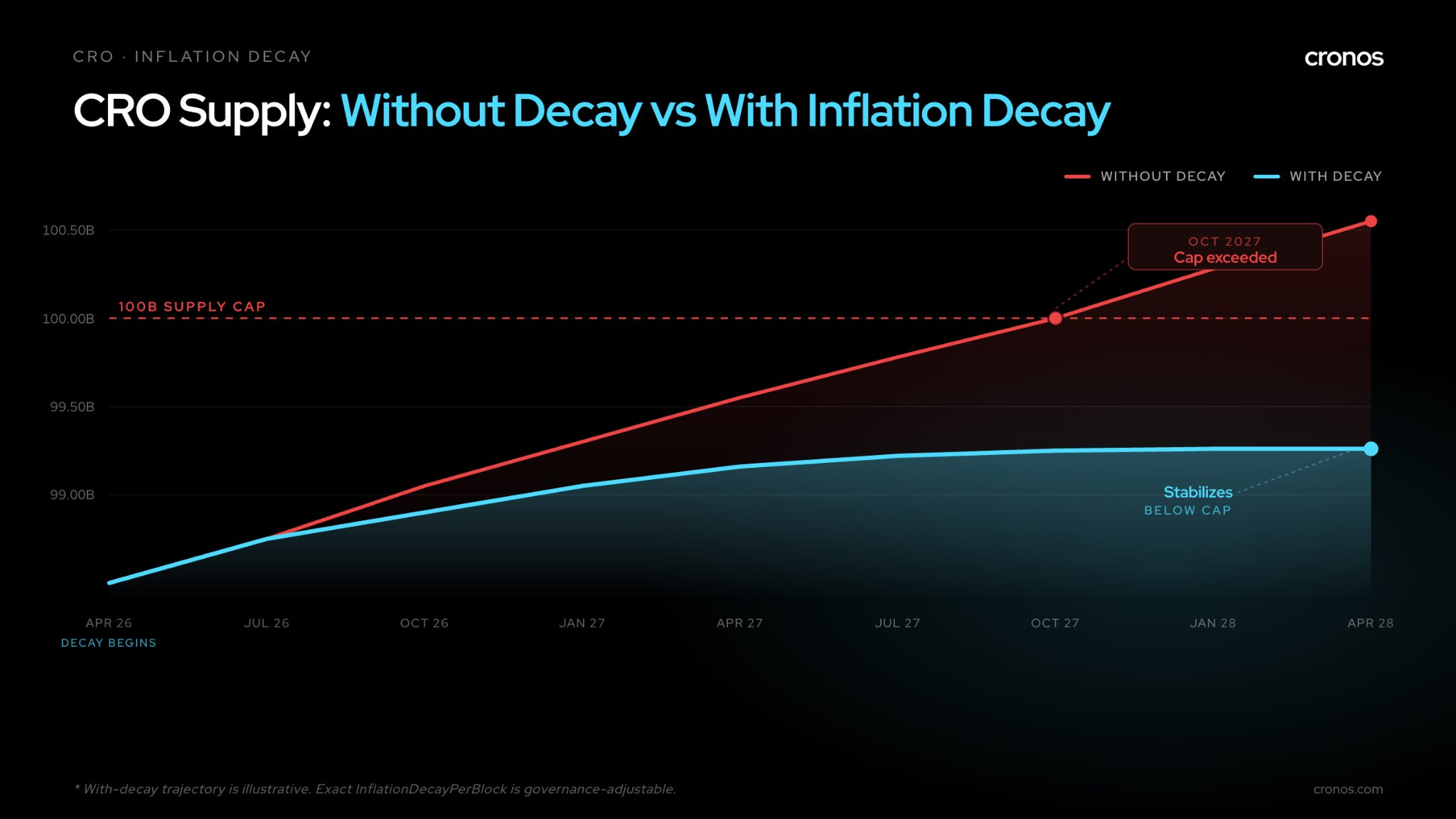
Both the rate and the pace of decay are governance-adjustable parameters. These parameters may be modified through future governance proposals, subject to community vote.
The 100 billion supply cap remains unchanged.
2. Staking rewards are tied to commitment
A new tiered staking model introduces time-locked staking positions. Longer lock-up periods are associated with higher potential reward rates.
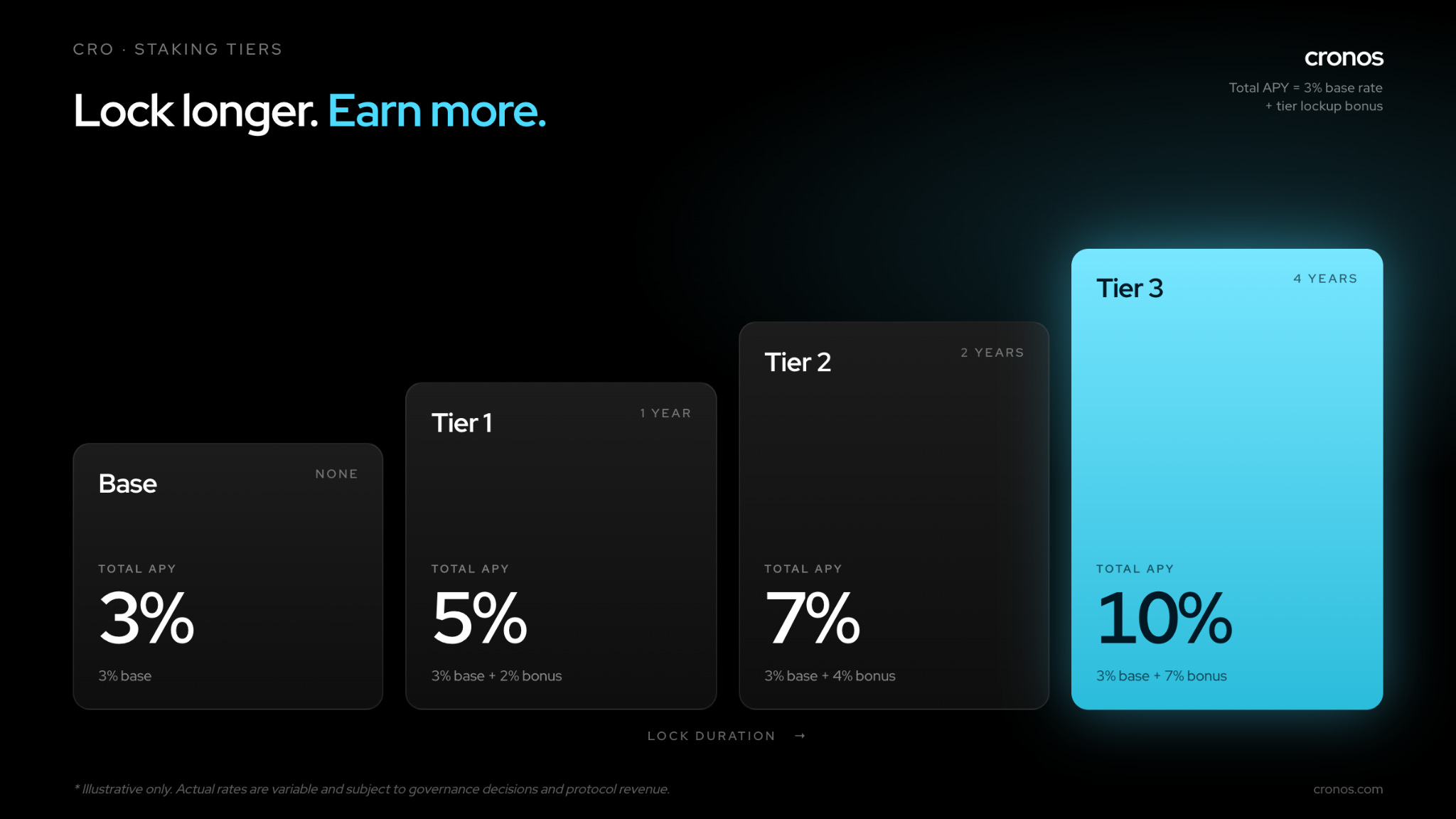
The difference: most proof-of-stake networks fund high yields through high inflation, which dilutes non-stakers.
CRO’s model is designed to fund rewards through protocol revenue entirely long-term. Higher potential yields come from longer commitment periods rather than relying indefinitely on new emissions
For existing stakers, the upgrade is designed to be simple:
Your current delegation continues as is.
Upgrading to a tier takes one transaction. No unbonding. No waiting. No re-delegation.
You keep your validator. You keep your voting rights. You can claim rewards at any time.
You can redelegate to a different validator without breaking your lock.
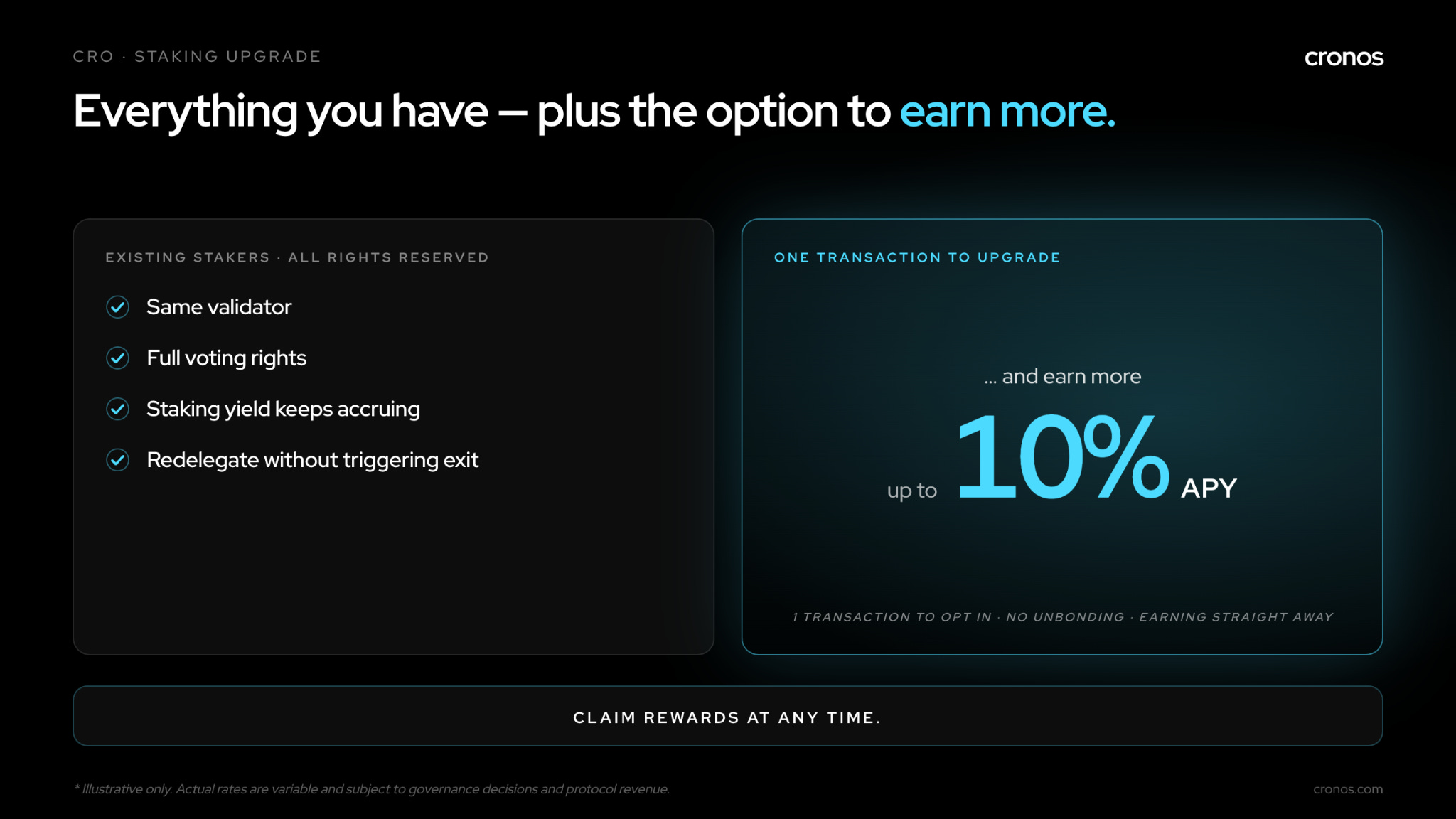
*APY is illustrative and applies to Tier 3 (4-year commitment). Actual rates are subject to governance decisions and available protocol revenue.
3. Revenue replaces emissions
As inflation decays, a new funding source takes over: real revenue from Cronos App and broader Cronos ecosystem activity.
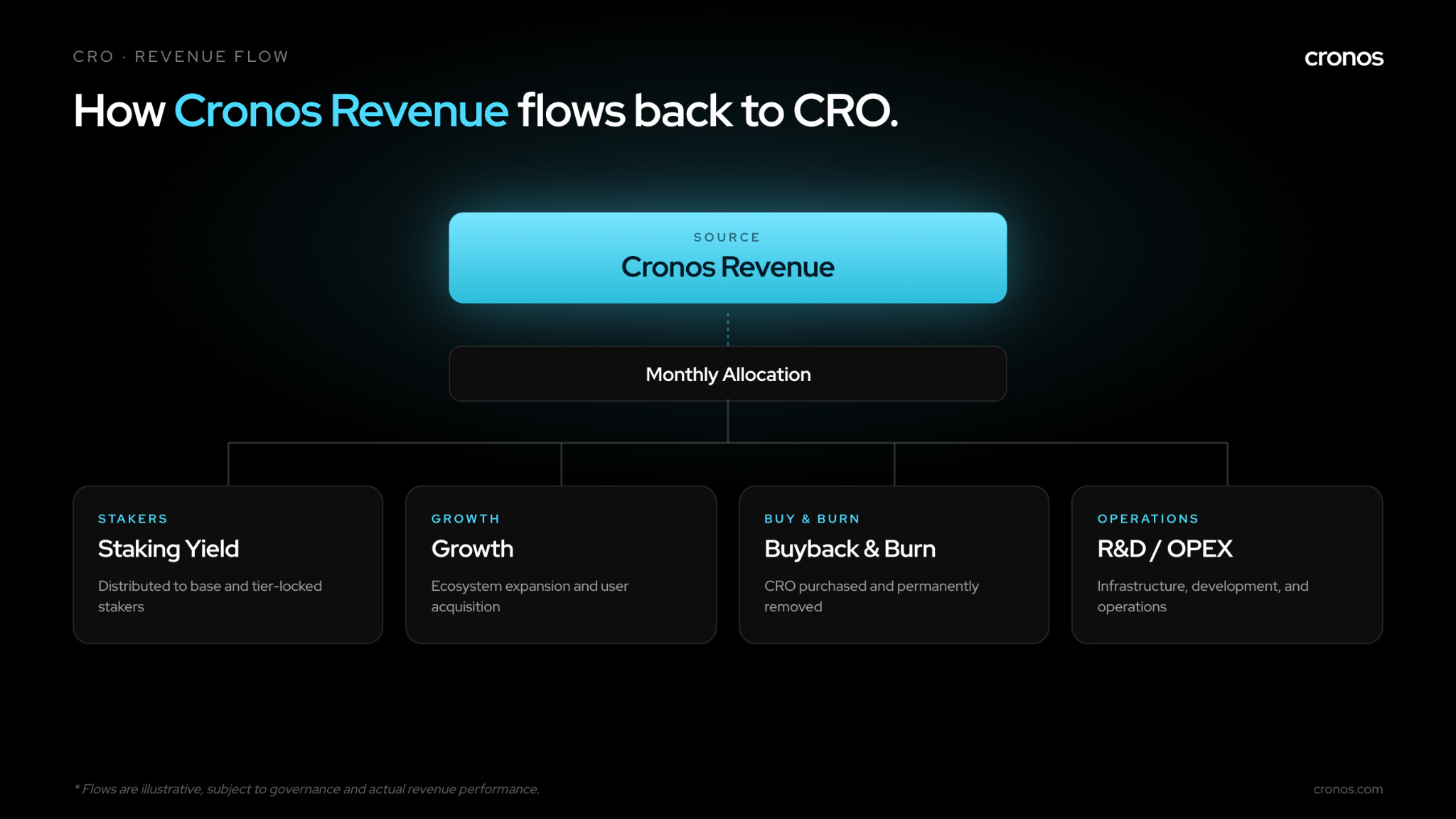
As Cronos scales, this revenue will be collected and directed into the ecosystem across four main buckets
Staking yield
Growth and user acquisition
Buyback and burn
R&D and operations
The Cronos App
Most Layer 1 blockchains fund staking rewards through inflation. That model has a ceiling. Cronos is building a different path: a product-led revenue engine connected back to CRO.
The Cronos App is a world-class mobile-first trading platform - stocks, prediction markets, and more - all in one account, available globally. It is built to power the economic model behind CRO. As it launches, it becomes the central driver of the flywheel.
As the Cronos App and broader ecosystem scale, they generate income from trading fees, DeFi yields, prediction markets, and network activity. Those flows return to CRO on a regular basis - transparent and auditable onchain.
Every trade, every fee, every dollar of activity feeds the engine. More users means more volume. More volume means a stronger CRO.
This is the flywheel. It runs on real economic activity.
This is what the new era for CRO looks like.
From emissions to revenue driven : The transition
Emissions do not drop to zero overnight. The decay is gradual, which gives the ecosystem time to scale revenue to support yields.
The strategic reserve exists as a bridge. While revenue ramps, the reserve supplements staking yields so the transition is smooth, not abrupt. The reserve does not constitute ongoing inflation. During the transition, it will fund staking rewards to maintain competitive yields while Cronos App revenue continues to ramp up as we grow.
This new tokenomics era is designed to align reserve deployment with growth ecosystem outcomes.
Right now, the staking yield comes from token emissions. Over time, two things happen in parallel: emissions decay by ~6.8% a month toward zero, and Cronos App revenue scales as we grow.
As revenue grows, the reserve does less of the work, until revenue fully covers staking rewards. That’s how CRO becomes a revenue-backed token, not by flipping a switch, but through gradual, visible progress.
The goal is clear: CRO’s long-term value should be driven by real revenue.
What happens next:
A new cronos.com launches in May with a dedicated tokenomics page - full visibility into supply, reserve, and revenue flows.
The governance proposal is live. Read it, share feedback, and vote: https://cronos-pos.org/explorer/proposal/33
For existing stakers: nothing changes unless you want it to. Your delegation continues as is. If you want higher yields, you can upgrade to a tier in a single transaction - no unbonding, no waiting.
For the community: this proposal marks a significant step. The Cronos App is being built, the website is being rebuilt, and the tokenomics are being restructured to support a revenue-backed model. This proposal is the first public proof of that work.
The flywheel starts now.