
Cronos Network v1.9 is the next network upgrade. Here’s a first look at what our core engineers are building right now.
In short:
Post-quantum signatures at the consensus layer, with ML-DSA validator keys inherited from the Cosmos SDK and CometBFT
Alignment with Ethereum’s upcoming Amsterdam hard fork: new opcodes, a multidimensional gas model and a faster EVM
A JSON-RPC API built for 0.5-second blocks
If you use Cronos Network, you don’t need to do anything today. Your existing accounts and wallets keep working as they are.
Why the post-quantum transition starts now
The signature schemes that secure Cronos Network today can’t be hardened against a quantum adversary. They have to be replaced, and replacing signatures on a live network is a multi-year effort.
Elliptic-curve signatures break outright. Accounts and transactions use ECDSA over secp256k1, as on Ethereum. Validators sign consensus votes with Ed25519, the CometBFT default. Both get their security from the elliptic-curve discrete logarithm problem, which Shor’s algorithm solves efficiently on a large enough quantum computer: given a public key, it recovers the private key. Bigger keys don’t help, because the weakness is structural. Hash functions are affected far less. Grover’s algorithm only reduces their security margin, so keccak256, Merkle trees and seed-phrase derivation remain sound.
Public ledgers are more exposed than most systems. The quantum threat is usually framed as “harvest now, decrypt later”: an adversary captures encrypted traffic first, then waits. A public ledger removes that first step. Every account that has sent a transaction has its public key recorded on-chain, permanently.
The attack is also forgery, not decryption. A quantum adversary doesn’t read old transactions. It signs new ones. Against validator keys, that means forged votes and forged blocks, which is an attack on consensus itself and on every IBC light client that trusts Cronos headers.
Resource estimates keep falling. No one can date the arrival of a cryptographically relevant quantum computer, but the published estimates move in one direction. In March 2026, Google Quantum AI estimated that breaking secp256k1 would take about 1,200 logical qubits and fewer than 500,000 physical qubits. That’s roughly a 20-fold drop in physical qubits compared with earlier estimates.
Standards bodies have already set the dates. NIST IR 8547, finalised in October 2026, deprecates ECDSA and EdDSA after 2030 and disallows them under NIST standards after 2035. The Ethereum Foundation has set its own target: a quantum-resistant L1 across execution, consensus and data layers by December 2029, planning for a break as early as 2030.
NIST guidance doesn’t regulate a blockchain directly. It reaches the network through custodians, exchanges, banks and asset issuers, who inherit these dates in their own audit and procurement requirements. A chain that secures tokenised assets needs a signature stack that stays acceptable into the 2030s.
Why validators come first. When the assets a system protects must stay secure for longer than a migration takes, the migration has to begin before the threat is certain. That’s the case for Cronos Network, so we’re starting with the layer the network controls end to end: validator consensus keys. This release lays the foundation by adding support for post-quantum validator keys.
ML-DSA at the consensus layer
Cronos Network v1.9 adopts Cosmos SDK v0.55 and CometBFT v0.40, which introduce ML-DSA-65 as a validator consensus key type. Our approach is to adopt published standards that are already implemented and reviewed upstream, not to design our own cryptography.
ML-DSA is the module-lattice signature scheme NIST standardized as FIPS 204 in August 2024, derived from CRYSTALS-Dilithium. It’s the general-purpose post-quantum signature most of the industry is converging on. Cosmos selected the ML-DSA-65 parameter set for consensus keys.
The trade-off is size:
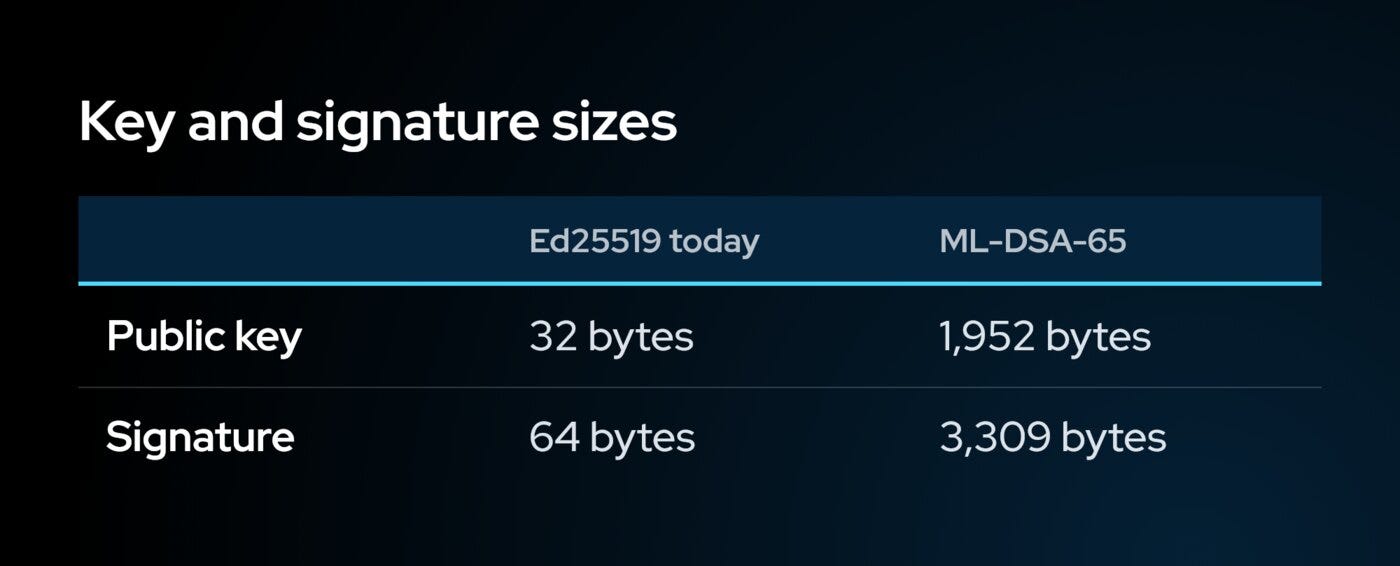
A block commit carries one signature per voting validator. For every 100 validators, signature data grows from 6.4 KB to about 331 KB per block.
What this release provides:
ML-DSA-65 consensus keys, opt-in. A chain enables the key type by adding ml_dsa_65 to the validator.pub_key_types consensus parameter. Ed25519 remains the default.
A migration path without a hard fork per validator. A validator can choose to move from an Ed25519 key to an ML-DSA-65 key through the new consensus key rotation message, keeping its operator address, voting power and delegations.
ML-DSA account keys on the Cosmos side. The keyring can create and recover ml_dsa_65 accounts, and the chain can verify their transactions. This is opt-in and doesn’t affect existing accounts.
Key management. Cosmos KMS adds AWS KMS and PKCS#11 backends, with ML-DSA-65 signing supported through AWS KMS.
A chain’s consensus is post-quantum secure once validators holding two-thirds of voting power sign with ML-DSA keys, the same threshold CometBFT uses to finalise blocks.
The plan for Cronos Network
Cronos Network v1.9 adds support for post-quantum validator keys. It doesn’t rotate any key by itself. Here’s the order we’ll roll it out in:
Testnet first. Cronos testnet moves to the v1.9 stack with ml_dsa_65 enabled alongside Ed25519. A subset of testnet validator keys is then rotated to ML-DSA-65, so the network runs with a mixed validator set.
Measure. The testnet phase is about data: block size, gossip load, block time and finality at 0.5-second blocks, state sync, and how relayers and indexers behave with larger commits.
Mainnet. At the v1.9 upgrade, every mainnet validator keeps its Ed25519 key. Whether and when mainnet validator keys move to ML-DSA-65 will depend on the testnet results, and we’ll coordinate any rotation with validator operators.
IBC also needs coordination. A counterparty chain verifies Cronos headers with its own light client code, so it must run a stack that can verify ML-DSA-65 signatures before Cronos validators switch. The same holds in reverse, and v1.9 lets Cronos Network verify counterparties that migrate first.
What’s still open
ML-DSA is the most mature option available today, but it isn’t the final answer for a high-throughput BFT chain. Several areas remain open:
Signature size, and no aggregation. An ML-DSA-65 signature is about 50 times larger than an Ed25519 one, and there’s no post-quantum equivalent of BLS aggregation. Commit size therefore grows linearly with the validator set. Active research includes SNARK-based aggregation of Falcon signatures, threshold ML-DSA, and the hash-based signatures with proof aggregation that Ethereum is pursuing for its own consensus layer.
Alternative schemes. FN-DSA (Falcon) offers much smaller signatures but is harder to implement safely and isn’t a final standard yet. SLH-DSA (FIPS 205) relies only on hash functions, a more conservative assumption than lattices, at the cost of larger signatures. The pub_key_types design keeps the chain crypto-agile, so more schemes can be added as they mature.
Implementation hardening. Lattice signing has a shorter deployment history than elliptic curves, and side-channel and fault attacks on ML-DSA implementations are an active research topic. Major HSM and cloud KMS vendors now support ML-DSA, but FIPS 140-3 validation of these implementations is still in progress.
Other cryptographic surfaces. Consensus keys are one layer. Peer-to-peer transport encryption, bridges, oracles and user accounts each need their own migration.
Accounts follow Ethereum
User accounts are a separate track. Cronos Network accounts are Ethereum accounts: the same addresses, transactions and wallets. A Cronos-specific post-quantum account scheme would break that compatibility.
Ethereum’s direction is to let each account choose its signature scheme, with native account abstraction (EIP-8141, frame transactions) as the first step. We’ll track that work and adopt it as it’s finalised.
If you use Cronos Network, you don’t need to do anything today. Your existing accounts and wallets keep working as they are.
Following Ethereum: the road to Amsterdam
Cronos Network v1.9 brings in the latest Ethereum execution-layer work. That means a faster EVM interpreter now, and a chain that’s ready for Amsterdam, Ethereum’s next execution-layer hard fork.
A faster EVM. The interpreter gains a pooled stack arena, in-place stack operations and a generated opcode dispatch loop. Contract semantics are unchanged, so existing contracts run as before, with less overhead per opcode. The toolchain also moves to Go 1.26, which turns on the Green Tea garbage collector by default and cuts the baseline overhead of cgo calls by about 30%, a direct gain for the storage layer.
Amsterdam. Amsterdam is the execution-layer half of Ethereum’s Glamsterdam upgrade. It’s in its testnet phase on Ethereum, and its mainnet date hasn’t been announced. The scheduled EIPs are listed in EIP-7773.
Cronos Network v1.9 already carries a large part of the Amsterdam implementation. We plan to enable it on Cronos Network once the fork is live on Ethereum mainnet and its specification is final, so Cronos Network developers get the same semantics as on Ethereum.
The changes most relevant to Cronos Network developers:
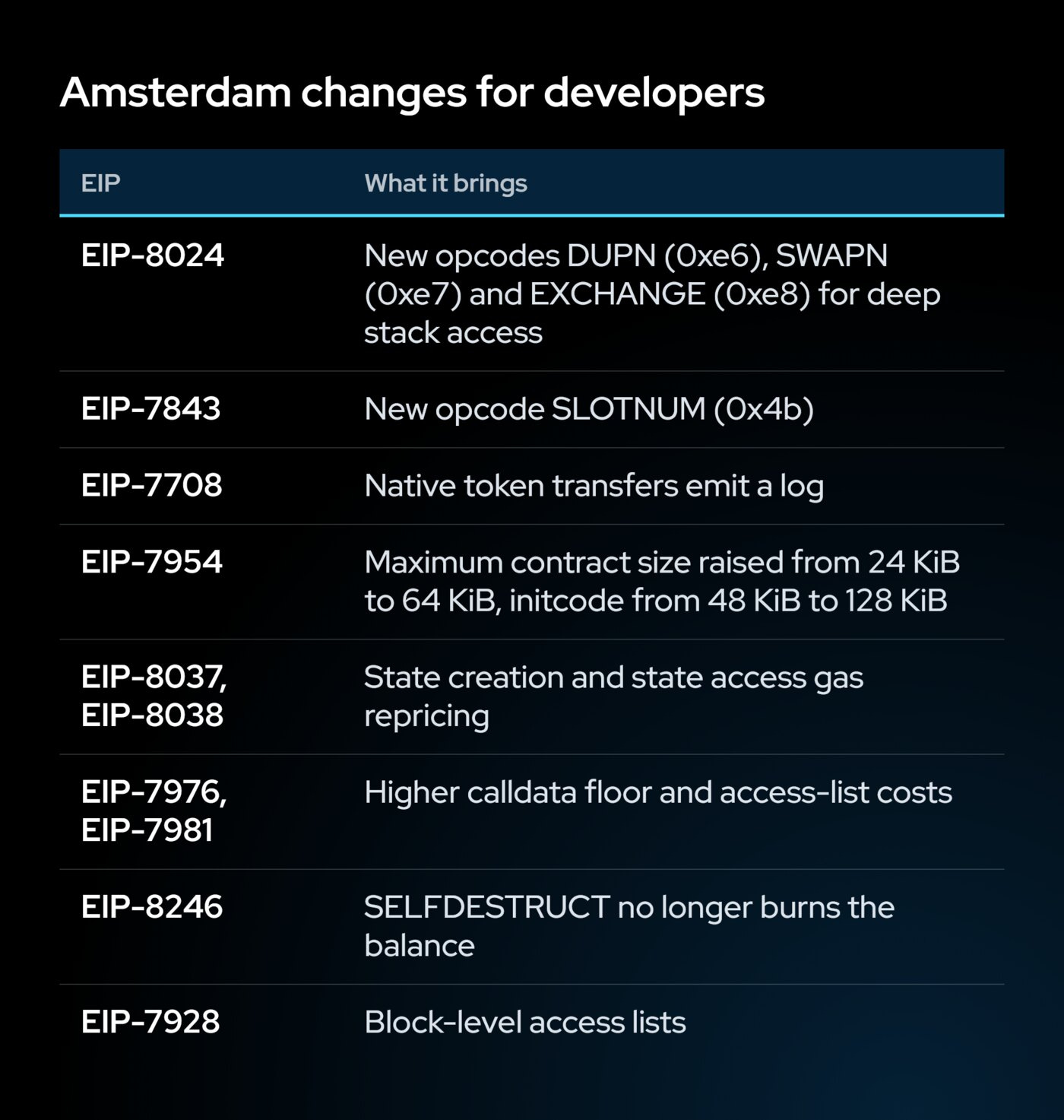
If you’re a developer, maintain tooling or run an indexer, review these in particular before Amsterdam is enabled on Cronos Network:
DUPN, SWAPN, EXCHANGE. The EVM can currently reach only the top 16 stack items, which is the main cause of Solidity’s “stack too deep” error. The new opcodes reach deeper, so compilers can generate simpler and cheaper code.
Transfer logs. With EIP-7708, a plain native-token transfer emits a log in the same form as an ERC-20 Transfer event. Indexers, explorers and exchanges can track CRO movements from logs alone, without tracing every transaction.
Larger contracts. The 24 KiB limit has shaped contract architecture for years. A 64 KiB limit removes many proxy and library workarounds.
Underneath, the EVM moves to a multidimensional gas model: execution gas and state gas are tracked separately, as EIP-8037 requires. This groundwork ships in v1.9 and has no effect on gas costs until Amsterdam is enabled.
JSON-RPC built for 0.5-second blocks
The previous Cronos Network upgrade brought block time down to about 0.5 seconds. The JSON-RPC work in v1.9 follows from that: clients need finer-grained data in fewer round trips, from an API that conforms to the Ethereum specification.
Millisecond timestamps. Ethereum block timestamps are in whole seconds. At two blocks per second, consecutive Cronos blocks share the same timestamp, which complicates ordering and latency measurement. So v1.9 adds millisecond fields next to the standard ones: timestampMs on blocks, and blockTimestampMs on transactions and logs. The standard timestamp field is unchanged, so existing tooling isn’t affected.
eth_sendRawTransactionSync. Today a client submits a transaction, gets a hash, then polls eth_getTransactionReceipt until the receipt is available. EIP-7966 folds this into a single call: the node holds the request open until the transaction is included and returns the receipt, or returns a timeout error carrying the transaction hash. With 0.5-second blocks, this cuts transaction confirmation to one round trip. It needs no consensus change and is planned for v1.9, with trading and payment flows in mind.
Conformance with the Ethereum specification. Cronos Network already serves the methods that wallets and tooling expect from an EVM chain, including:
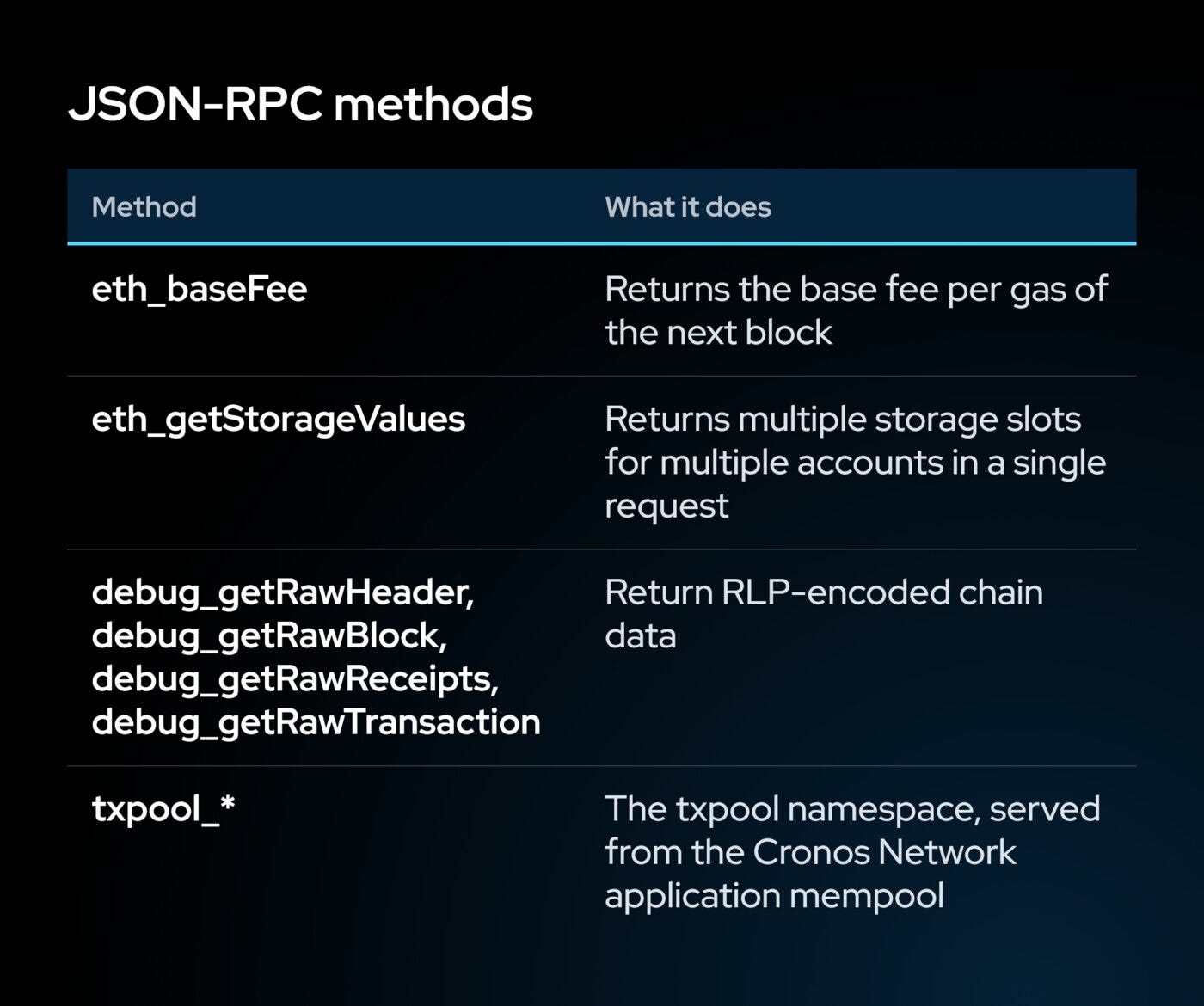
Responses are now validated against the official ethereum/execution-apis test fixtures. In v1.9, eth_simulateV1 and eth_createAccessList are aligned more closely with go-ethereum, error codes included.
Hardened public endpoints. Public RPC nodes are the most exposed surface of any chain. EVM queries such as eth_call, eth_estimateGas, eth_simulateV1 and debug_trace* now stop when the request times out or is cancelled. The eth_getLogs method caps its address and topic filters, and eth_feeHistory percentiles and WebSocket subscriptions per connection are bounded.